View My Stats

Friday, July 12, 2019

Impetus for investigation to include dismissal of James Comey

Impetus for investigation

Mueller Report

On May 9, 2017 President Donald Trump dismissed the Director of the FBI, James Comey, who had been leading an ongoing FBI investigation into links between Trump Associates & Russian Officials. This investigation began in July 2016 due to the unwitting revelation by foreign policy advisor Geotge Papadopoulos that the Trump campaign knew, before anyone else, that the Russians possessed emails stolen from Hillary Clinton;

Over 130 Democratic lawmakers of the United States Congress called for a special counsel to be appointed in reaction to Comey's firing. CNN reported that within eight days of Comey's dismissal, an FBI investigation on Trump for obstruction of justice was opened by the acting FBI Director at the time, Andrew McCabe, who cited multiple reasons including Comey's firing.After McCabe was later fired from the FBI, he confirmed that he had opened the obstruction investigation, and gave additional reasons for its launch.


Eight days after Comey's dismissal, then-Deputy Attorney General Rod Rosenstein appointed Robert Mueller, as special counsel to take over and expand an existing FBI counterintelligence investigation into possible Russian interference in the 2016 United States elections, as well as the FBI investigation nto links between Trump associates and Russian officials that Comey was leading.[The special counsel also took over the FBI investigation into whether President Trump obstructed justice with Comey.[Rosenstein's authority to appoint Mueller arose due to Attorney General Jeff Sessions.' March 2017 recusal of himself from investigations into the Trump campaign.


Scope and mandate

According to its authorizing document, which was signed by then-Deputy Attorney General Rod Rosenstein on May 17, 2017, the investigation's scope included allegations that there were links or coordination between Donald Trump's presidential campaign and the Russian government as well as "any matters that arose or may arise directly from the investigation". The authorizing document also included "any other matters within the scope of 28 CFR § 600 enabling the special counsel "to investigate and prosecute" any attempts to interfere with its investigation, "such as perjury, obstruction of justice, destruction of evidence and intimidation of witnesses".

Proceedings of investigation


The Mueller Report included references to 14 criminal investigations that were referred to other offices, 12 of which were completely redacted in the April 18 release. The other two related to Michael Cohen and Gregory Craig, cases that were already public.

Wednesday, July 10, 2019

Findings feature Volume 1 on various topics: like the Russians

Findings

Volume 1: starts on page one of the report & focuses on Rusian interference and allegations of consprity or coordination between Trump's presidential campaign and Russia.

Russian interference

The Mueller Report found that the Russian government "interfered in the 2016 presidential election in sweeping and systematic fashion" and "violated U.S. criminal law". The report relayed two methods by which Russia attempted to influence the election.
Social media campaign
The first method of Russian interference was done through the Internet Research Agency (IRA), waging "a social media campaign that favored presidential candidate Donald J. Trump and disparaged presidential candidate Hillary Clinton."The IRA also sought to "provoke and amplify political and social discord in the United States".

By February 2016, internal IRA documents showed an order to support the candidacies of Donald Trump and ,Bernie Sanders while IRA members were to "use any opportunity to criticize" Hillary Clinton and the rest of the candidates. From June 2016, the IRA organized election rallies in the U.S. "often promoting" Trump's campaign while "opposing" Clinton's campaign.acting as Americans, hiding their Russian background, while asking Trump campaign members for campaign buttons, flyers, and posters for the rallies. The Mueller Report detailed that the IRA spent $100,000 for over 3,500 Facebook advertisements, which included anti-Clinton and pro-Trump advertisements.

The report lists IRA-created groups on Facebook to include "purported conservative groups" (e.g. 'Tea Party News'), "purported Black social justice groups" (e.g. 'Blacktivist') "LGBTQ groups" (e.g. 'LGBT United'), "and religious groups" (e.g. 'United Muslims of America') The IRA Twitter accounts included @TEN_GOP (claiming to be related to the Tennessee Republican Party), @jenn_abrams, and @Pamela_Moore13 (both claimed to be Trump supporters and both had 70,000 followers). Several Trump campaign members (Donald J. Trump Jr., Eric Trump, Kellyanne Conway, Brad Parscale and Michael Flynn) linked or reposted material from the IRA's @TEN_GOP Twitter account listed above. Other people who responded to IRA social media accounts include Michael McFaul, Sean Hannitt, Roger Stone, and Michael G. Flynn (Michael Flynn's son).
Hacking and release of material
The second method of Russian interference saw the Russian military intelligence agency GRU hacking into email accounts owned by volunteers and employees of the Clinton presidential campaign, including that of campaign chairman John Podesta, and also hacking into "the computer networks of the Democratic Congressional Campaign Committee (DCCC) and the Democratic National Committee (DNC)". As a result, the GRU obtained hundreds of thousands of hacked documents, and the GRU proceeded by arranging releases of damaging hacked material via the WikiLeaks organization and also GRU's false personas "SDLeaks" and "Guccifer 2.02.0"

Conspiracy or coordination

To establish whether a crime was committed by members of the Trump campaign with regard to Russian interference, investigators "applied the framework of conspiracy law", and not the concept of "collusion", because collusion "is not a specific offense or theory of liability found in the United States Code, nor is it a term of art in federal criminal law."They also investigated if members of the Trump campaign "coordinated" with Russia, using the definition of "coordination" as having "an agreement – tacit or express – between the Trump campaign and the Russian government on election interference." Investigators further elaborated that merely having "two parties taking actions that were informed by or responsive to the other's actions or interests" was not enough to establish coordination.

The investigation found there were over 100 contacts between Trump campaign advisors and individuals affiliated with the Russian government, before and after the election, but the evidence was insufficient to show an illegal conspiracyThe New York Times estimated as many as 140 contacts between "Mr. Trump and his associates and Russian nationals and WikiLeaks or their intermediaries" in the report.

The special counsel identified two methods the Russian government tried to communicate with the Trump campaign. "The investigation identified two different forms of connections between the IRA and members of the Trump Campaign. [...] First, on multiple occasions, members and surrogates of the Trump Campaign promoted – typically by linking, retweeting, or similar methods of reposting – pro-Trump or anti-Clinton content published by the IRA through IRA-controlled social media accounts. Additionally, in a few instances, IRA employees represented themselves as U.S. persons to communicate with members of the Trump Campaign in an effort to seek assistance and coordination on IRA-organized political rallies inside the United States", the report states.

Secondly, the report details a meeting at Trump Tower in June 2016. The intent of the meeting was to exchange "dirt" on the Clinton campaign. There was speculation that Trump Jr. told his father. However, the special counsel could not find any evidence that he did The office declined to pursue charges for two reasons: the office "did not obtain admissible evidence" that would meet the burden of proof principle beyond a reasonable doubt that the campaign officials acted with general knowledge about the illegality of their conduct; secondly, the office expected difficulty in valuing the promised information that "exceeded the threshold for a criminal violation" of $2,000 for a criminal violation and $25,000 for a felony punishment.

The Report cited several impediments to investigators' ability to acquire information, including witnesses invoking their Fifth Amendment right against self-incrimination, witnesses deleting electronic communications or using encrypted or self-destructing messaging apps, limitations of interviewing attorneys or individuals asserting they were members of the media, information obtained through subpoenas that was screened from investigators due to legal privilege, and false or incomplete testimony provided by witnesses.[6][7][96][8][97]

Tuesday, July 09, 2019

Beginning of full text of Robert Muellar's Report Summaries


EXECUTIVE SUMMARY TO VOLUME I
RUSSIAN SOCIAL MEDIA CAMPAIGN
The Internet Research Agency (IRA) carried out the earliest Russian interference operations identified by the investigation—a social media campaign designed to provoke and amplify political and social discord in the United States. The IRA was based in St. Petersburg, Russia, and received funding from Russian oligarch Yevgeniy Prigozhin and companies he controlled. Prigozhin is widely reported to have ties to Russian President Vladimir Putin, [Redacted: Harm to Ongoing Matter]

In mid-2014, the IRA sent employees to the United States on an intelligence-gathering mission with instructions [Redacted: Harm to Ongoing Matter]

The IRA later used social media accounts and interest groups to sow discord in the U.S. political system through what it termed "information warfare." The campaign evolved from a generalized program designed in 2014 and 2015 to undermine the U.S. electoral system, to a targeted operation that by early 2016 favored candidate Trump and disparaged candidate Clinton. The IRA's operation also included the purchase of political advertisements on social media in the names of U.S. persons and entities, as well as the staging of political rallies inside the United States. To organize those rallies, IRA employees posed as U.S. grassroots entities and persons and made contact with Trump supporters and Trump Campaign officials in the United States. The investigation did not identify evidence that any U.S. persons conspired or coordinated with the IRA. Section II of this report details the Office's investigation of the Russian social media campaign.

RUSSIAN HACKING OPERATIONS
At the same time that the IRA operation began to focus on supporting candidate Trump in early 2016, the Russian government employed a second form of interference: cyber intrusions (hacking) and releases of hacked materials damaging to the Clinton Campaign. The Russian intelligence service known as the Main Intelligence Directorate of the General Staff of the Russian Army (GRU) carried out these operations.

In March 2016, the GRU began hacking the email accounts of Clinton Campaign volunteers and employees, including campaign chairman John Podesta. In April 2016, the GRU hacked into the computer networks of the Democratic Congressional Campaign Committee (DCCC) and the Democratic National Committee (DNC). The GRU stole hundreds of thousands of documents from the compromised email accounts and networks. Around the time that the DNC announced in mid-June 2016 the Russian government's role in hacking its network, the GRU began disseminating stolen materials through the fictitious online personas "DCLeaks" and "Guccifer 2.0." The GRU later released additional materials through the organization WikiLeaks.

The presidential campaign of Donald J. Trump ("Trump Campaign" or "Campaign") showed interest in WikiLeaks's releases of documents and welcomed their potential to damage candidate Clinton. Beginning in June 2016, [Redacted: Harm to Ongoing Matter] forecast to senior Campaign officials that WikiLeaks would release information damaging to candidate Clinton. WikiLeaks's first release came in July 2016. Around the same time, candidate Trump announced that he hoped Russia would recover emails described as missing from a private server used by Clinton when she was Secretary of State (he later said that he was speaking sarcastically). [Redacted: Harm to Ongoing Matter] WikiLeaks began releasing Podesta’s stolen emails on October 7, 2016, less than one hour after a U.S. media outlet released video considered damaging to candidate Trump. Section III of this Report details the Office's investigation into the Russian hacking operations, as well as other efforts by Trump Campaign supporters to obtain Clinton-related emails.

RUSSIAN CONTACTS WITH THE CAMPAIGN
The social media campaign and the GRU hacking operations coincided with a series of contacts between Trump Campaign officials and individuals with ties to the Russian government. The Office investigated whether those contacts reflected or resulted in the Campaign conspiring or coordinating with Russia in its election-interference activities. Although the investigation established that the Russian government perceived it would benefit from a Trump presidency and worked to secure that outcome, and that the Campaign expected it would benefit electorally from information stolen and released through Russian efforts, the investigation did not establish that members of the Trump Campaign conspired or coordinated with the Russian government in its election interference activities.

The Russian contacts consisted of business connections, offers of assistance to the Campaign, invitations for candidate Trump and Putin to meet in person, invitations for Campaign officials and representatives of the Russian government to meet, and policy positions seeking improved U.S.-Russian relations. Section IV of this Report details the contacts between Russia and the Trump Campaign during the campaign and transition periods, the most salient of which are summarized below in chronological order.

2015. Some of the earliest contacts were made in connection with a Trump Organization real-estate project in Russia known as Trump Tower Moscow. Candidate Trump signed a Letter of Intent for Trump Tower Moscow by November 2015, and in January 2016 Trump Organization executive Michael Cohen emailed and spoke about the project with the office of Russian government press secretary Dmitry Peskov. The Trump Organization pursued the project through at least June 2016, including by considering travel to Russia by Cohen and candidate Trump.

Spring 2016. Campaign foreign policy advisor George Papadopoulos made early contact with Joseph Mifsud, a London-based professor who had connections to Russia and traveled to Moscow in April 2016. Immediately upon his return to London from that trip, Mifsud told Papadopoulos that the Russian government had "dirt" on Hillary Clinton in the form of thousands of emails. One week later, in the first week of May 2016, Papadopoulos suggested to a representative of a foreign government that the Trump Campaign had received indications from the Russian government that it could assist the Campaign through the anonymous release of information damaging to candidate Clinton. Throughout that period of time and for several months thereafter, Papadopoulos worked with Mifsud and two Russian nationals to arrange a meeting between the Campaign and the Russian government. No meeting took place.

Summer 2016. Russian outreach to the Trump Campaign continued into the summer of 2016, as candidate Trump was becoming the presumptive Republican nominee for President. On June 9, 2016, for example, a Russian lawyer met with senior Trump Campaign officials Donald Trump Jr., Jared Kushner, and campaign chairman Paul Manafort to deliver what the email proposing the meeting had described as "official documents and information that would incriminate Hillary." The materials were offered to Trump Jr. as "part of Russia and its government's support for Mr. Trump." The written communications setting up the meeting showed that the Campaign anticipated receiving information from Russia that could assist candidate Trump's electoral prospects, but the Russian lawyer's presentation did not provide such information.

Days after the June 9 meeting, on June 14, 2016, a cybersecurity firm and the DNC announced that Russian government hackers had infiltrated the DNC and obtained access to opposition research on candidate Trump, among other documents.

In July 2016, Campaign foreign policy advisor Carter Page traveled in his personal capacity to Moscow and gave the keynote address at the New Economic School. Page had lived and worked in Russia between 2003 and 2007. After returning to the United States, Page became acquainted with at least two Russian intelligence officers, one of whom was later charged in 2015 with conspiracy to act as an unregistered agent of Russia. Page's July 2016 trip to Moscow and his advocacy for pro-Russian foreign policy drew media attention. The Campaign then distanced itself from Page and, by late September 2016, removed him from the Campaign.

July 2016 was also the month WikiLeaks first released emails stolen by the GRU from the DNC. On July 22, 2016, WikiLeaks posted thousands of internal DNC documents revealing information about the Clinton Campaign. Within days, there was public reporting that U.S. intelligence agencies had "high confidence" that the Russian government was behind the theft of emails and documents from the DNC. And within a week of the release, a foreign government informed the FBI about its May 2016 interaction with Papadopoulos and his statement that the Russian government could assist the Trump Campaign. On July 31, 2016, based on the foreign government reporting, the FBI opened an investigation into potential coordination between the Russian government and individuals associated with the Trump Campaign.

Separately, on August 2, 2016, Trump campaign chairman Paul Manafort met in New York City with his long-time business associate Konstantin Kilimnik, who the FBI assesses to have ties to Russian intelligence. Kilimnik requested the meeting to deliver in person a peace plan for Ukraine that Manafort acknowledged to the Special Counsel's Office was a "backdoor" way for Russia to control part of eastern Ukraine; both men believed the plan would require candidate Trump's assent to succeed (were he to be elected President). They also discussed the status of the Trump Campaign and Manafort's strategy for winning Democratic votes in Midwestern states. Months before that meeting, Manafort had caused internal polling data to be shared with Kilimnik, and the sharing continued for some period of time after their August meeting.

Fall 2016. On October 7, 2016, the media released video of candidate Trump speaking in graphic terms about women years earlier, which was considered damaging to his candidacy. Less than an hour later, WikiLeaks made its second release: thousands of John Podesta's emails that had been stolen by the GRU in late March 2016. The FBI and other U.S. government institutions were at the time continuing their investigation of suspected Russian government efforts to interfere in the presidential election. That same day, October 7, the Department of Homeland Security and the Office of the Director of National Intelligence issued a joint public statement "that the Russian Government directed the recent compromises of e-mails from US persons and institutions, including from US political organizations." Those "thefts" and the "disclosures" of the hacked materials through online platforms such as WikiLeaks, the statement continued, "are intended to interfere with the US election process."

Post-2016 Election. Immediately after the November 8 election, Russian government officials and prominent Russian businessmen began trying to make inroads into the new administration. The most senior levels of the Russian government encouraged these efforts. The Russian Embassy made contact hours after the election to congratulate the President-Elect and to arrange a call with President Putin. Several Russian businessmen picked up the effort from there.

Kirill Dmitriev, the chief executive officer of Russia's sovereign wealth fund, was among the Russians who tried to make contact with the incoming administration. In early December, a business associate steered Dmitriev to Erik Prince, a supporter of the Trump Campaign and an associate of senior Trump advisor Steve Bannon. Dmitriev and Prince later met face-to-face in January 2017 in the Seychelles and discussed U.S.-Russia relations. During the same period, another business associate introduced Dmitriev to a friend of Jared Kushner who had not served on the Campaign or the Transition Team. Dmitriev and Kushner's friend collaborated on a short written reconciliation plan for the United States and Russia, which Dmitriev implied had been cleared through Putin. The friend gave that proposal to Kushner before the inauguration, and Kushner later gave copies to Bannon and incoming Secretary of State Rex Tillerson.

On December 29, 2016, then-President Obama imposed sanctions on Russia for having interfered in the election. Incoming National Security Advisor Michael Flynn called Russian Ambassador Sergey Kislyak and asked Russia not to escalate the situation in response to the sanctions. The following day, Putin announced that Russia would not take retaliatory measures in response to the sanctions at that time. Hours later, President-Elect Trump tweeted, "Great move on delay (by V. Putin)." The next day, on December 31, 2016, Kislyak called Flynn and told him the request had been received at the highest levels and Russia had chosen not to retaliate as a result of Flynn's request.
***
On January 6, 2017, members of the intelligence community briefed President-Elect Trump on a joint assessment—drafted and coordinated among the Central Intelligence Agency, FBI, and National Security Agency—that concluded with high confidence that Russia had intervened in the election through a variety of means to assist Trump's candidacy and harm Clinton's. A declassified version of the assessment was publicly released that same day.

Between mid-January 2017 and early February 2017, three congressional committees—the House Permanent Select Committee on Intelligence (HPSCI), the Senate Select Committee on Intelligence (SSCI), and the Senate Judiciary Committee (SJC)—announced that they would conduct inquiries, or had already been conducting inquiries, into Russian interference in the election. Then-FBI Director James Comey later confirmed to Congress the existence of the FBI's investigation into Russian interference that had begun before the election. On March 20, 2017, in open-session testimony before HPSCI, Comey stated:
I have been authorized by the Department of Justice to confirm that the FBI, as part of our counterintelligence mission, is investigating the Russian government's efforts to interfere in the 2016 presidential election, and that includes investigating the nature of any links between individuals associated with the Trump campaign and the Russian government and whether there was any coordination between the campaign and Russia's efforts. . . . As with any counterintelligence investigation, this will also include an assessment of whether any crimes were committed.
The investigation continued under then-Director Comey for the next seven weeks until May 9, 2017, when President Trump fired Comey as FBI Director—an action which is analyzed in Volume II of the report.

On May 17, 2017, Acting Attorney General Rod Rosenstein appointed the Special Counsel and authorized him to conduct the investigation that Comey had confirmed in his congressional testimony, as well as matters arising directly from the investigation, and any other matters within the scope of 28 C.F.R. § 600.4(a), which generally covers efforts to interfere with or obstruct the investigation.

President Trump reacted negatively to the Special Counsel's appointment. He told advisors that it was the end of his presidency, sought to have Attorney General Jefferson (Jeff) Sessions unrecuse from the Russia investigation and to have the Special Counsel removed, and engaged in efforts to curtail the Special Counsel's investigation and prevent the disclosure of evidence to it, including through public and private contacts with potential witnesses. Those and related actions are described and analyzed in Volume II of the report.
***
THE SPECIAL COUNSEL'S CHARGING DECISIONS
In reaching the charging decisions described in Volume I of the report, the Office determined whether the conduct it found amounted to a violation of federal criminal law chargeable under the Principles of Federal Prosecution. See Justice Manual § 9-27.000 et seq. (2018). The standard set forth in the Justice Manual is whether the conduct constitutes a crime; if so, whether admissible evidence would probably be sufficient to obtain and sustain a conviction; and whether prosecution would serve a substantial federal interest that could not be adequately served by prosecution elsewhere or through non-criminal alternatives. See Justice Manual § 9-27.220
.
Section V of the report provides detailed explanations of the Office's charging decisions, which contain three main components.

First, the Office determined that Russia's two principal interference operations in the 2016 U.S. presidential election—the social media campaign and the hacking-and-dumping operations—violated U.S. criminal law. Many of the individuals and entities involved in the social media campaign have been charged with participating in a conspiracy to defraud the United States by undermining through deceptive acts the work of federal agencies charged with regulating foreign influence in U.S. elections, as well as related counts of identity theft. See United States v. Internet Research Agency, et al., No. 18-cr-32 (D.D.C.). Separately, Russian intelligence officers who carried out the hacking into Democratic Party computers and the personal email accounts of individuals affiliated with the Clinton Campaign conspired to violate, among other federal laws, the federal computer-intrusion statute, and they have been so charged. See United States v. Netyksho, et al., No. 18-cr-215 (D.D.C.). [Redacted: Harm to Ongoing Matter, Personal Privacy]

Second, while the investigation identified numerous links between individuals with ties to the Russian government and individuals associated with the Trump Campaign, the evidence was not sufficient to support criminal charges. Among other things, the evidence was not sufficient to charge any Campaign official as an unregistered agent of the Russian government or other Russian principal. And our evidence about the June 9, 2016 meeting and WikiLeaks's releases of hacked materials was not sufficient to charge a criminal campaign-finance violation. Further, the evidence was not sufficient to charge that any member of the Trump Campaign conspired with representatives of the Russian government to interfere in the 2016 election.

Third, the investigation established that several individuals affiliated with the Trump Campaign lied to the Office, and to Congress, about their interactions with Russian-affiliated individuals and related matters. Those lies materially impaired the investigation of Russian election interference. The Office charged some of those lies as violations of the federal false statements statute. Former National Security Advisor Michael Flynn pleaded guilty to lying about his interactions with Russian Ambassador Kislyak during the transition period. 

George Papadopoulos, a foreign policy advisor during the campaign period, pleaded guilty to lying to investigators about, inter alia, the nature and timing of his interactions with Joseph Mifsud, the professor who told Papadopoulos that the Russians had dirt on candidate Clinton in the form of thousands of emails. Former Trump Organization attorney Michael Cohen pleaded guilty to making false statements to Congress about the Trump Moscow project. [Redacted: Harm to Ongoing Matter] And in February 2019, the U.S. District Court for the District of Columbia found that Manafort lied to the Office and the grand jury concerning his interactions and communications with Konstantin Kilimnik about Trump Campaign polling data and a peace plan for Ukraine.
***
The Office investigated several other events that have been publicly reported to involve potential Russia-related contacts. For example, the investigation established that interaction between Russian Ambassador Kislyak and Trump Campaign officials both at the candidate's April 2016 foreign policy speech in Washington, D.C., and during the week of the Republican National Convention were brief, public, and non-substantive. And the investigation did not establish that one Campaign official's efforts to dilute a portion of the Republican Party platform on providing assistance to Ukraine were undertaken at the behest of candidate Trump or Russia. The investigation also did not establish that a meeting between Kislyak and Sessions in September 2016 at Sessions's Senate office included any more than a passing mention of the presidential campaign.
The investigation did not always yield admissible information or testimony, or a complete picture of the activities undertaken by subjects of the investigation.

Some individuals invoked their Fifth Amendment right against compelled self-incrimination and were not, in the Office's judgment, appropriate candidates for grants of immunity. The Office limited its pursuit of other witnesses and information—such as information known to attorneys or individuals claiming to be members of the media—in light of internal Department of Justice policies. See, e.g., Justice Manual §§ 9-13.400, 13.410. 

Some of the information obtained via court process, moreover, was presumptively covered by legal privilege and was screened from investigators by a filter (or "taint") team. Even when individuals testified or agreed to be interviewed, they sometimes provided information that was false or incomplete, leading to some of the false-statements charges described above. And the Office faced practical limits on its ability to access relevant evidence as well-numerous witnesses and subjects lived abroad, and documents were held outside the United States.

Further, the Office learned that some of the individuals we interviewed or whose conduct we investigated—including some associated with the Trump Campaign—deleted relevant communications or communicated during the relevant period using applications that feature encryption or that do not provide for long-term retention of data or communications records. In such cases, the Office was not able to corroborate witness statements through comparison to contemporaneous communications or fully question witnesses about statements that appeared inconsistent with other known facts.

Accordingly, while this report embodies factual and legal determinations that the Office believes to be accurate and complete to the greatest extent possible, given these identified gaps, the Office cannot rule out the possibility that the unavailable information would shed additional light on (or cast in a new light) the events described in the report.obstruction-of-justice inquiry focused on a series of actions by the President that related to the Russian-interference investigations, including the President's conduct towards the law enforcement officials overseeing the investigations and the witnesses to relevant events.

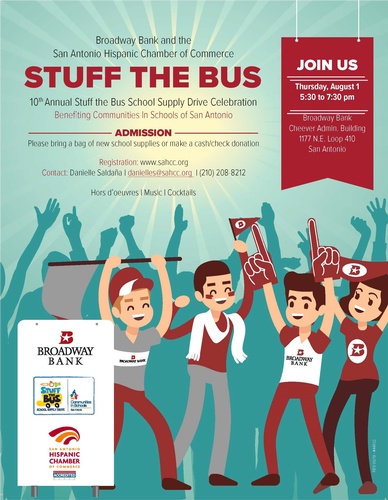
10th Annual Chamber Stuff the Bus Supply Drive Celebration, 8-1

Join the San Antonio Hispanic Chamber of Commerce at our Upcoming Events! 
10th Annual Stuff the Bus School 
Supply Drive Celebration
Please join the San Antonio Hispanic Chamber of Commerce and Broadway Bank for our 10th Annual "Stuff the Bus" School Supply Drive Celebration benefiting Communities in Schools of San Antonio! Help us raise funds and donate school supplies to those in need! 
The San Antonio Hispanic Chamber of Commerce is now accepting any school supplies donations at our front office! 
If you are interested in hosting a drive at your place of business or would like to volunteer for Communities in Schools, please click here!
School supplies and cash donations accepted as entry to this event
Thursday, August 1, 2019
5:30 p.m. - 7:30 p.m.
Broadway Bank
Cheever Building
San Antonio, TX 78209
EVENT SPONSORS

Sunday, July 07, 2019

"Just A Thought" in La Prensa Texas on history of 4th of July, 7-7

Mini History of 4th of July
By Steve Walker

This past Thursday we celebrated the 4th of July like we do every year.
Many people think we celebrate the Fourth of July because it is the day we received our Independence from England. But have you ever wondered how it actually came about?

While many are thinking along the right track it is not the entire reason we celebrate the Fourth of July, nor is it the reason that the Fourth of July holiday came about for that matter.
Remembering that in the 18th century the United States was not considered the “United States.” In actuality, they were actually called “colonies.” Our country was in reality an extension of England. People traveled from England aboard ships to settle in America. As we learned later that our differences in life, thought, and interests began to develop a rift, we began to tear apart.
When the “colonies” were first settled, they had free reign to develop their communities with little or no oversight. Unfortunately things quickly began to change in 1763. Britain suddenly decided that they needed to take more control over the colonies. They also thought the colonies needed to return revenue to the mother country and they needed to pay for the colonies defense, which was being provided by Britain.
Obviously as history tells us, the colonies did not agree with these new rules at all and expressed their disagreement. Many “colonists,” felt that since they were not represented in Parliament, that they shouldn’t have to pay any kinds of taxes to the mother country, hence those famous words, “no taxation without representation.”
When Britain continued to tax, the colonies formed the First Continental Congress to persuade the British government to recognize their rights. When this didn’t work a war was declared, which is known as the American Revolution.
After the First Continental Congress failed to persuade Britain to recognize the colonies’ rights, and war was declared, things began to heat up. Many people who were both considered moderates and radicals had decided that enough was enough and that any kind of taxation without representation was considered tyranny. Nothing has changed.
People such as John Adams, Samuel Adams, and Ben Franklin, as well as a group called the “Sons of Liberty” decided that it was time to unite all of the colonies and to stand together against Britain.
A second Continental Congress formed during the course of the American Revolution. It is this group that adopted the final draft of the Declaration of Independence.
History tells us that it was drafted by John Adams, Ben Franklin, Thomas Jefferson, Robert R. Livingston, and Roger Sherman. After the first draft was written by Thomas Jefferson, it was revised by Ben Franklin, John Adams, and Thomas Jefferson before it was sent to Congress for approval. All thirteen colonies united behind the Declaration of Independence and adopted it in full on July 4th 1776.
Like many immigrants from the past from all the various counties around the world, the immigrants of today fighting to come to America for a better life, has only just begun.
The inscription at the base of the Statue of Liberty reads: "Give me, your tired, your poor, your huddled masses yearning to breathe free, the wretched refuse of your teeming shore.” Isn’t that what we are seeing now at our southern border? Having said all that, hoping you had an enjoyable 4th of July.
And as always, what I write is “Just a Thought.”
Thursday, July 04, 2019

More photos @ Woodlawn Park covering many people there, 6-4

 More people turn out for 4th of July 
celebration @ Woodlawn Park